
The Moment You Notice It
You hit the button, watch the door start down, and then — without warning — it stops a foot off the ground and climbs right back up. Or maybe nothing happens at all: the door just sits there, lights blinking, motor humming, going nowhere. Either way, it's the kind of thing that makes you stand in the driveway wondering if you're going to be fighting this door every night until someone fixes it.
The good news is that a reversing or non-closing garage door almost always points to one of a handful of causes, and most of them are things a technician checks in the same order every time. Working through that same order yourself can save you a service call, or at least help you describe the problem clearly when you make one.
What You're Actually Seeing
- Reverses partway down — the door starts closing, touches close to the floor or stops midway, then reverses to full open.
- Reverses immediately — the door barely moves before heading back up.
- Won't close at all — you hold the button and the door doesn't move, or it moves a few inches and stalls.
- Closes fine with the wall button but not the remote (or vice versa) — this points toward sensors or signal issues rather than mechanical ones.
The Causes, in the Order a Technician Checks Them
1. Safety Sensors (Photo-Eyes)
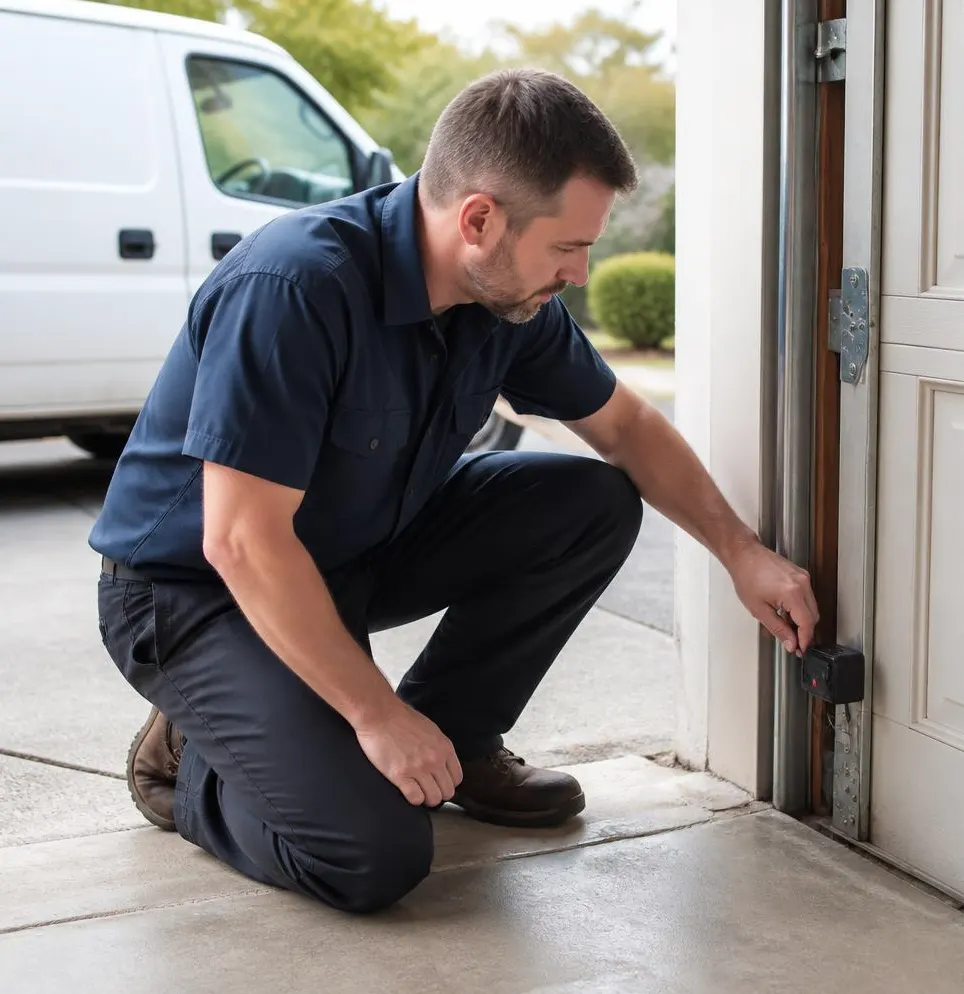
This is the first thing any technician looks at, because it's the most common cause and the easiest to fix. Every garage door built in the last few decades has two small sensors mounted a few inches off the floor on each side of the track. If their line of sight is blocked, dirty, or even slightly misaligned, the opener assumes something is in the door's path and reverses it as a safety measure.
Fall is rough on these sensors. Pine pollen and debris coat the lenses, spiderwebs stretch across the beam overnight, and heavy rain can leave moisture or condensation on the lens that scatters the light. Wipe both lenses with a soft cloth, check that nothing — a stored bike, a leaf blower, a stray box — is sitting in the beam's path, and look at the mounting brackets. If one sensor has been bumped and is pointing slightly off from the other, the door won't close until they're realigned so both indicator lights glow solid.
2. Obstructions in the Track or Door Path
Next, a technician runs the door through a full cycle while watching the tracks. A small dent, a buildup of dirt and pine needles, or a bent section of track can cause the door to catch just enough to trigger the opener's resistance sensor, which reads the catch as an obstruction and reverses the door. This is especially common in garages that back up to wooded areas, where debris accumulates in the tracks between regular use.
3. Opener Force and Limit Settings
If the sensors and tracks check out, the next stop is the opener's force and limit settings. These settings tell the opener how far to travel and how much resistance to tolerate before reversing. Over time — especially after a cold snap tightens metal components or humidity swells wood trim — these settings can drift out of calibration, causing the door to reverse before it actually hits anything. Adjusting them involves small dial or button changes on the opener unit itself, followed by test cycles to confirm the door now travels the correct distance and seats properly against the floor.
4. Worn or Weakening Springs
If the door struggles, reverses under strain, or won't close because it's fighting gravity unevenly, the springs are often the real issue. Torsion and extension springs lose tension gradually, and a door with weak springs makes the opener work harder than it's designed to, triggering safety reversals. Spring replacement is not a DIY project — these components are under heavy tension — but it's a common and permanent fix once diagnosed.
5. Rollers, Hinges, and Track Alignment
Worn rollers or loose hinges can cause the door to bind at a specific spot every time, which an opener reads as resistance. A technician checks for rollers that wobble, hinges with play in them, or tracks that have drifted slightly out of parallel — common after years of humidity and temperature swings affecting the garage framing.
6. Opener Logic Board or Motor
If every mechanical and sensor check comes back clean, the issue may be electrical — a failing circuit board or motor capacitor that's no longer reading the door's position correctly. This is the least common cause but the one that usually requires full opener diagnostics or replacement.
When to Call Oak Ridge Garage Door Co
If you've checked the sensors and tracks and the door is still reversing or refusing to close, it's time to call in a technician rather than keep adjusting settings by trial and error. Our team handles everything from opener repair and recalibration to spring replacement, and we won't leave until the door opens and closes smoothly through a full cycle, every time.
Don't let a reversing door turn into a security gap or a wasted morning. Call Oak Ridge Garage Door Co for fast, honest service anywhere in Oak Ridge, TN and the surrounding area.